Drata alternative · Compared in depth

Looking for a Drata alternative? An honest comparison with Acuna GRC.

Direct answer

Acuna GRC is a Drata alternative for fast-growing companies closing enterprise deals that ask for ISO 27001 and security questionnaires, regulated EU enterprises running NIS2 and DORA in one record, groups with a head office and subsidiaries, MSSPs and consultancies, and organizations that want the full cycle run with experts. It is a Swiss GRC platform with 50+ frameworks in one library, Aiko working on the same records as every module, hosting in Switzerland or the EU, and a published starting price of CHF 6'390 per year, per organization rather than per seat. Drata stays the stronger pick for US federal frameworks such as FedRAMP, CMMC and HITRUST.

Switch to Acuna GRC if

  • You are closing enterprise deals that ask for ISO 27001 and security questionnaires.
  • Your obligations are European or Swiss (NIS2, DORA, FINMA, Swiss FADP, EU AI Act) and you want them in the library, not rebuilt as custom frameworks.
  • You run a head office and subsidiaries, a Microsoft-centric or hybrid stack, or many clients as an MSSP or consultancy.
  • You want AI working natively on your compliance records, and experts who can run the full cycle with you.
  • You want a published starting price and organization-based pricing before the first call.

Stay with Drata if

  • You need US federal or sector frameworks such as FedRAMP, CMMC or HITRUST.
  • You are a US cloud-native team that wants to choose its audit firm from Drata’s Auditor Alliance.
Book a demoSee pricing

Why do teams look for a Drata alternative?

Teams rarely leave Drata because the core product is weak. The reasons that do come up are cost and how it grows, automated tests that fail or pass for the wrong reason, integration depth, auditor workflow, internal effort, and fit for European regulation. Each one below carries the evidence we could verify and how Acuna GRC handles it.

  1. Pricing you cannot see, and cost that grows

    What the evidence says

    Drata publishes plans (Foundation, Advanced, Enterprise) but no prices. Vendr reports a median of $24,934 a year across 236 purchases, ranging from $9,415 to $68,250 (February 2026).[4][16][17]

    “Frameworks can get expensive over time.”

    G2 review listed on AWS Marketplace, August 2026

    How Acuna GRC answers it

    Acuna GRC publishes its starting price: from CHF 6'390 per year, per organization, not per seat. Core GRC includes the library of 50+ frameworks, so adding NIS2 to an ISO 27001 program is a mapping exercise. Add-on modules are quoted with your offer. How pricing works

  2. Automated tests that fail, or pass, for the wrong reason

    What the evidence says

    Drata runs continuous automated tests. Some reviewers report results that do not match reality and ask for faster ways to deal with faulty tests.[18][17]

    “their UI shows many false positives, indicating that requirements are taken care of even when they’re not.”

    PeerSpot review, 1/5, July 2025

    How Acuna GRC answers it

    In Acuna GRC a control is judged one of three ways: by a connector metric against a target, by records being completed, or by a signed checklist. Health is computed on a worst-wins rule from control to measure to requirement, so one green result cannot hide a failing area, and nobody types a health score in by hand.

  3. Integration depth

    What the evidence says

    Drata integrates with "hundreds of tools". Reviewers praise the breadth and still point to gaps for specific systems.[5][18]

    “there are still some gaps.”

    PeerSpot review, August 2024

    How Acuna GRC answers it

    Acuna GRC has 100+ connectors and builds new ones on request. Jira and ServiceNow sync tasks both ways, and systems without a connector (an on-premise CMDB, a procurement tool) push a CSV to a scheduled import. API v1 and signed webhooks cover the rest. Integrations and API

  4. Auditor workflow

    What the evidence says

    Drata’s Audit Hub centralizes auditor collaboration, evidence requests and approvals. Not every team gets it working smoothly.[6][18]

    “our auditors could not access the Audit Hub in Drata”

    PeerSpot review, February 2026

    How Acuna GRC answers it

    Acuna GRC has certified lead auditors in house who prepare the audit with you. In Assure, an audit carries its period, and its records are grouped as in period, undated or other periods, with links to requirements, measures, issues and corrective actions. Your auditor signs in with an access profile limited to what they need, and reports export to PDF or Excel. Assure

  5. Hidden internal effort

    What the evidence says

    The subscription is only part of the cost. Setup and test tuning take internal time that rarely appears in the quote.[18]

    “cost me probably 10 hours a week while we were still trying to get Drata to work.”

    PeerSpot review, July 2025

    How Acuna GRC answers it

    Every Acuna GRC subscription includes a dedicated advisor and one month of hypercare. The compliance roadmap seeds tasks, controls and documents for your frameworks, and Swiss experts can co-manage or fully manage the program. Services

  6. US and SOC 2-first DNA

    What the evidence says

    Drata is headquartered in San Francisco and grew from SOC 2. It does list NIS 2 and DORA among its 30+ pre-built frameworks, and its API documentation lists regional instances for North America, Europe and Asia-Pacific. FINMA, the Swiss FADP and the EU AI Act are not on its framework list.[10][2][3]

    How Acuna GRC answers it

    Acuna GRC is built in Switzerland. NIS2, DORA, FINMA and the Swiss FADP sit in the same library as ISO 27001 and SOC 2 and share measures and controls, and your data is hosted in Switzerland or the EU, as you choose, with self-hosting on request.

Drata vs Acuna GRC: how do they compare?

Both platforms monitor controls continuously. Drata grew from SOC 2 automation for cloud-native companies and has widened its platform through the SafeBase acquisition and a TPRM product sold on its own. Acuna GRC runs every module and Aiko on one data model, is built for European and Swiss regulation, groups and service providers, and publishes its price. The last column says honestly who has the edge on each line.

Drata vs Acuna GRC comparison, as of November 2026
CriterionAcuna GRCDrataEdge
Target marketFast-growing startups closing enterprise deals, regulated EU enterprises under NIS2 and DORA, groups with subsidiaries, MSSPs and consultancies, organizations that want the full cycle run with expertsStartups, growing companies and enterprises, from continuous monitoring as you build to several business units and regions; US-headquartered[1][10]BothBoth serve growing companies; Acuna GRC also fits EU regulated groups and MSSPs
Frameworks50+ in the library, included in Core GRC: NIS2, DORA, FINMA, Swiss FADP, GDPR, EU AI Act, ISO 27001, ISO 42001, SOC 2; custom frameworks by CSV30+ pre-built, including SOC 2, ISO 27001, NIS 2, DORA, GDPR, ISO 42001, FedRAMP, CMMC, HITRUST, TISAX; custom frameworks[2]DependsAcuna GRC for Swiss law; Drata for US federal
Jurisdiction and hostingSwiss company; hosting in Switzerland or the EU, as the customer chooses; self-hosting on requestUS-headquartered (San Francisco); regional instances for North America, Europe and Asia-Pacific in its API docs[10][3]Acuna GRCSwiss jurisdiction and self-hosting
Continuous monitoring and workflowConnectors record control passes and fails and KPI values every 4 hours; endpoint posture through the Intune, Defender, CrowdStrike, Jamf and Sophos connectors; requirement, measure, control and task linked, with approvals and reviews built inContinuous monitoring and automated tests; its own endpoint agent checks encryption, screen lock, antivirus, password manager and updates[9]BothBoth monitor continuously; your stack decides
EvidenceConnector results recorded automatically; records created from the work itself, naming who did it and when; signed checklist PDFs; browser extension stamps pasted screenshots with UTC time and the user’s emailEvidence collected automatically from integrations and the agent; Audit Hub for auditor requests[6]BothBoth collect automatically; Acuna GRC also records who did the work
Integrations100+ connectors, and new ones built on request around your stack; Jira and ServiceNow two-way task sync; API v1, webhooks, scheduled CSV imports"Hundreds of tools"[5]DependsDrata: larger ready-made catalog; Acuna GRC: connectors built to your stack
Pricing modelPublished: from CHF 6'390 per year, per organization, no per-seat fees; add-on modules quotedQuote-only plans; Foundation covers up to 50 FTEs, and Vendr reports that price scales with employee count; independent estimate: $24,934 median per year (Vendr)[4][16]Acuna GRCPrice you can see
Trust Center and TPRMTrust Center: public trust page with open and gated tiers, gated documents behind an NDA signature, questionnaire answers drafted only from approved library facts, each showing what it was built from, and a log of every view and download; TPRM: assessments, campaigns, supplier portalTrust Center built on SafeBase (acquired for $250M, 2025); agentic TPRM sold as an independent product since September 2026[14][13]BothBoth cover it; Acuna GRC answers from the same records as your program
AIAiko is native to the platform and works on the same records and one data model (requirements, measures, controls, risks, suppliers, evidence), so its proposals rest on connected data: it answers, drafts tasks and KPIs, links records in bulk runs and proposes risk scores from their evidence; a person confirms under the policy an administrator sets; AI Governance module available nowAgentic questionnaire response (March 2026); AI Agent Governance in limited availability (August 2026); Trust Center from the SafeBase acquisition and agentic TPRM as a separate product[11][12][14][13]Acuna GRCNative to one data model
Multi-entity and groupsGroup management: head office and subsidiaries, group users, shared suppliers, group KPIs, Group Compliance dashboard; scopes per entityWorkspaces, "designed to scale across multiple frameworks, workspaces, and complex org structures"[8]DependsBoth handle several entities; Acuna GRC adds a group dashboard across them
AuditorsIn-house certified lead auditors; your auditor signs in with an access profile limited to what they needAudit Hub for auditor collaboration; Auditor Alliance of 175+ audit firms[6][7]DependsIn-house lead auditors or a network of firms
ServicesDedicated advisor and one month of hypercare included; co-managed or fully managed; CISO and DPO as a service; in-house certified lead auditorsGuided implementation (typically 4 to 6 weeks) with customer success and compliance advisors; audits through Auditor Alliance firms[8][7]Acuna GRCIn-house experts and managed services
MSSP and partnersEach client in its own organization, white label under your brandPartner and reseller channel in Europe via Exclusive Networks[15]DependsBoth run partner programs

Drata facts as of November 2026, from the pages in the sources below. Acuna GRC security documentation, and how Aiko handles data, are in the Acuna Trust Center.

Trust Center: questionnaire answers are drafted only from facts you approved, each shows what it was built from, and an answer citing a draft document is flagged before anyone approves it.
TPRM: every supplier with its risk level, its assessment rating and a daily public-exposure grade, on the same records as your controls.

What does Acuna GRC look like in under two minutes?

The Acuna GRC film shows the platform in 1 minute 39 seconds: why GRC keeps getting harder, cross-framework mapping and dashboards, and Aiko working on your compliance and risk data. It plays only when you click.

Watch the film · 1:39

Acuna GRC home

Acuna GRC in 1 minute 39 seconds: one connected compliance platform with 50+ frameworks, cross-framework control mapping, risk, TPRM, privacy, audit and AI governance, GRC dashboards, and Aiko, the AI assistant built into every page.

Chapters

  1. Why GRC and compliance are getting harder
  2. Meet Acuna GRC
  3. Cross-framework mapping and GRC dashboards
  4. Aiko: AI for compliance and risk
  5. Results: less manual work, faster compliance
Watch on YouTube

How much does Drata cost compared to Acuna GRC?

Drata does not publish prices. Independent estimates from Vendr put the median Drata contract at $24,934 a year, with a range of $9,415 to $68,250. Acuna GRC starts from CHF 6'390 a year for one organization, with Core GRC and 50+ frameworks included. Over three years, framework and module add-ons, renewal terms, internal effort and services usually decide the real difference more than the first-year price.

Drata pricing: independent estimates and published facts
ItemFigureWhere it comes from
List priceNot publishedDrata’s pricing page shows Foundation, Advanced and Enterprise plans, each leading to a sales conversation.[4]
Median annual contract$24,934Independent estimate, Vendr, based on 236 purchases, February 2026.[16]
Range of contracts$9,415 to $68,250 a yearIndependent estimate, Vendr, February 2026.[16]
Cost as frameworks growNot publishedA G2 reviewer, August 2026: "Frameworks can get expensive over time."[17]

What to count in a three-year comparison

Frameworks and modules

Ask what each extra framework, Trust Center, TPRM or AI module adds to the Drata quote. In Acuna GRC the 50+ frameworks sit in Core GRC; you choose which add-on modules to add.

Renewals

Get renewal terms in writing for both vendors. Vendr’s range shows how widely contracts vary, and the year-two number matters more than the first.

Internal effort

Count the hours spent tuning tests, chasing evidence and explaining exceptions to auditors. One PeerSpot reviewer put setup at about 10 hours a week.

Services and the audit

Budget the audit firm and any implementation help with either vendor. Acuna GRC includes a dedicated advisor and one month of hypercare, and offers co-managed and fully managed services.

Which is better for NIS2, DORA, FINMA, the Swiss FADP and the EU AI Act?

For NIS2 and DORA both platforms ship pre-built frameworks, so the difference is design: in Acuna GRC they sit in one library with ISO 27001 and SOC 2 and share measures, controls and records, while Drata maps them onto a control model that grew from SOC 2. For FINMA, the Swiss FADP and the EU AI Act, Acuna GRC covers them and Drata’s published framework list does not, so you would build them as custom frameworks.

NIS2, DORA, FINMA, Swiss FADP and EU AI Act: Acuna GRC vs Drata, as of November 2026
RegulationAcuna GRCDrata
NIS2In the library, mapped to shared measures; Group Compliance shows every entity in scopeNIS2 explainedNIS2 compliance softwarePre-built (listed as NIS 2)[2]
DORAIn the library, with the third-party register, business impact analysis and incident timelines on the same dataDORA explainedDORA compliance softwarePre-built[2]
FINMAIn the library, adopted next to DORA, with BIA and providers ratedFINMA compliance softwareNot on Drata’s framework list; possible as a custom framework[2]
Swiss FADPIn the library; with Data Privacy it drives legal bases, the ROPA and DPIAsSwiss FADP explainedFADP compliance softwareNot on Drata’s framework list; GDPR is pre-built[2]
EU AI ActAI Governance module: register of AI systems, impact assessments, human oversight, incidents and a contestation channelEU AI Act explainedAI GovernanceNot on its list; ISO 42001, NIST AI RMF and AIUC-1 are, and AI Agent Governance is in limited availability[2][12]
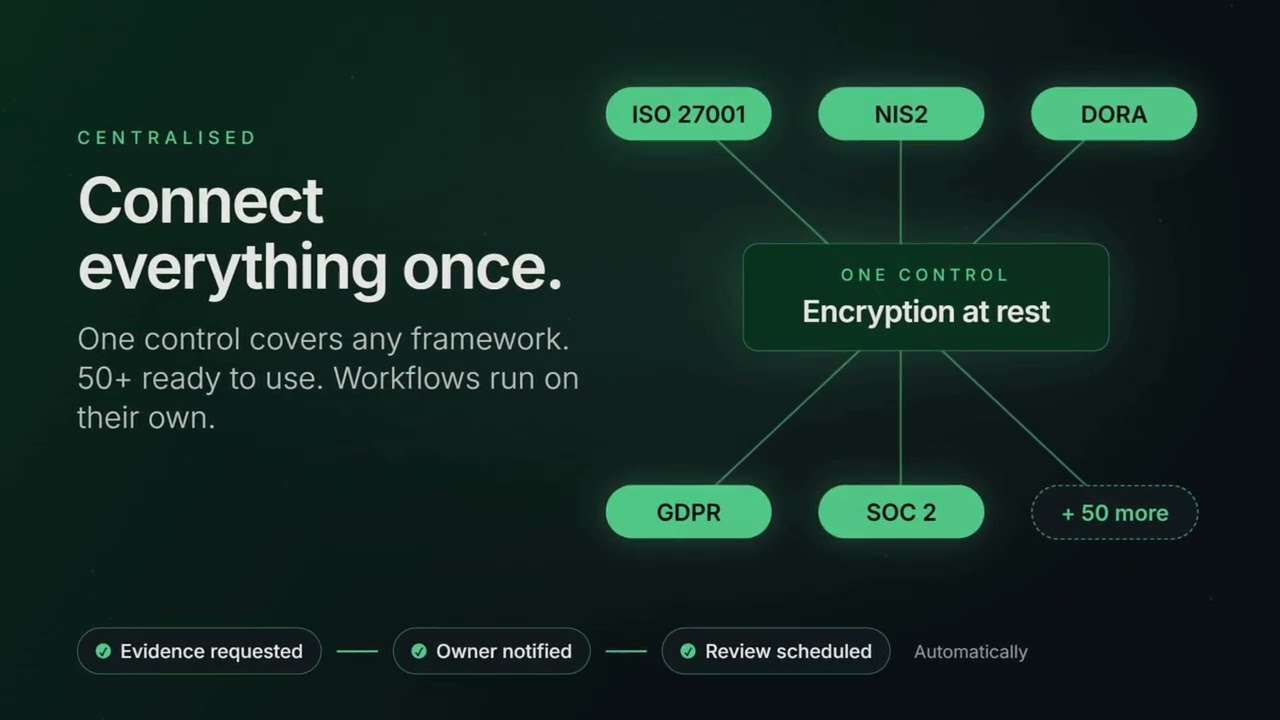
One control library across frameworks: each measure is linked to every requirement it meets, so a framework you add reuses the work already done.

How does Acuna GRC make evidence auditors can trust?

Acuna GRC is workflow-first. Every requirement is met by a measure, verified by a control and carried out through tasks, and each completion records who did it, when, and the record that proves it. Health is computed from that chain, never typed in.

Records from the work itself

Completing a task or a control execution creates or links a typed, dated record that names who did the work. A checklist run is signed item by item and files its own PDF record.

Approvals and reviews built in

Risks, documents and exceptions move through approval workflows with a history of every state change. Yearly reviews come with reminders 30 days and 3 days before, and when overdue.

Evidence from the browser

The Acuna browser extension (v0.13.0, Chrome and Edge) shows your tasks, controls, approvals, reviews and deadlines in a popup or side panel, with notifications. A screenshot you paste as evidence is stamped with the UTC date and time and your Acuna email before it is sent. Sign-in with Microsoft, no telemetry.

Extension privacy notice

Connector results where they fit

Connectors record control passes and fails and KPI values every 4 hours. Where no connector understands your stack, a control is judged on completed records or a checklist instead, so every control still produces evidence.

Evidence: a control names its owner, how it is judged and when it is due, and each run is signed and filed as a record.
Approvals: a policy is published only after its approvers sign, and every change is a numbered revision.

When is Acuna GRC a better choice than Drata?

Acuna GRC is the better choice for fast-growing startups closing enterprise deals that ask for ISO 27001 and security questionnaires, regulated EU enterprises running NIS2 and DORA in one record, groups with a head office and subsidiaries, MSSPs and consultancies, organizations that want the full cycle run with experts, Microsoft-centric and hybrid IT teams, and teams that want AI working natively on their compliance records.

Buyers for whom Acuna GRC is the better choice than Drata, as of November 2026
BuyerBetter choiceWhy
Fast-growing startups closing enterprise deals that ask for ISO 27001 and security questionnairesAcuna GRCThe Trust Center, questionnaire drafts from approved library facts and one audit log answer due diligence requests from one set of records, and the compliance roadmap sets up the program in one approval step.Trust CenterCompliance roadmapISO 27001
Regulated EU enterprises that must run NIS2 and DORA obligations in one recordAcuna GRCIncident reports, supplier assessments and exceptions sit together with shared owners and dates, and ISO 27001 measures link to the same controls.NIS2DORATPRMMeasures and controls
Enterprises with a head office and subsidiaries that want one view across entitiesAcuna GRCGroup management and group dashboards cover the head office and its subsidiaries, while each entity keeps its own records.Group management
MSSPs and consultancies running compliance for several clientsAcuna GRCClient management and white-label portals under the provider’s own brand.GRC for MSSPsPartner program
Organizations that want the full compliance cycle run with experts on the same recordsAcuna GRCCompliance roadmap, one control library across more than 50 frameworks, and CISO and DPO services that run or support any part of the cycle.ServicesCISO as a serviceDPO as a service
Microsoft-centric and hybrid IT teamsAcuna GRCEntra ID, Intune, Defender, Sentinel and Secure Score connectors, sign-in with Microsoft, Teams summaries, and scheduled imports from on-premise systems.Integrations and API
Teams that want AI working natively on their compliance recordsAcuna GRCAiko is built into every page and works on the same records as every module, so it answers from your own data, drafts tasks, links controls to measures in bulk runs and proposes a new risk score with the evidence behind it. A person confirms, under the policy your administrator sets, and every action is logged.AikoAI Governance
Aiko works on the same records as every module: it gathers a risk’s control runs, KPIs, vulnerable items and threats, each with its source and date, and proposes a new score for a person to confirm.
Group management: one view across the head office and its subsidiaries, worst first, while each entity keeps its own records.

When is Drata the better choice?

Choose Drata when US federal or sector frameworks decide the purchase, or when you are a US cloud-native team that wants to choose its audit firm from Drata’s Auditor Alliance. These are real strengths:

Buyers for whom Drata is the better choice than Acuna GRC, as of November 2026
BuyerBetter choiceWhy
Teams that need US federal or sector frameworksDrataFedRAMP, CMMC, HITRUST, NYDFS and SOX ITGC are on Drata’s list.[2]
US cloud-native teams that want to choose an audit firm from a marketplaceDrataDrata’s Auditor Alliance lists 175+ audit firms that work with customers in its Audit Hub.[7][6]

What are the other Drata alternatives?

The main Drata alternatives each suit a different buyer. Vanta suits teams that want the widest integration catalog, Secureframe teams that want experts alongside automation, Sprinto fast-growing companies covering many frameworks, and Kertos German and EU companies that want a European vendor. Acuna GRC suits fast-growing startups closing enterprise deals, regulated EU enterprises under NIS2 and DORA, groups with subsidiaries, MSSPs and consultancies.

Drata alternatives and who each suits, as described on each vendor’s site, November 2026
PlatformWho it suits
VantaCompanies that want the broadest integration catalog (400+ tools) and 35+ frameworks in a large ecosystem.[19]
SecureframeTeams that want compliance automation backed by in-house experts.[20]
SprintoFast-growing SMB and mid-market companies covering many frameworks; its frameworks page lists 200+.[21]
KertosGerman and EU companies that want a vendor made in Germany, with NIS2, GDPR, the EU AI Act, ISO 27001, TISAX and C5.[22]
Acuna GRCFast-growing startups closing enterprise deals, regulated EU enterprises under NIS2 and DORA, groups with subsidiaries, MSSPs and consultancies, and organizations that want the full cycle run with experts, with NIS2, DORA, FINMA and the Swiss FADP in the library.

If Swiss jurisdiction is what decides it, compare Acuna GRC with Swiss GRC too.

How do you migrate from Drata to Acuna GRC?

You move in four steps: bring in what you have, map it once across frameworks, connect your systems, then run. Your dedicated advisor plans the order with you, and how long it takes depends on how many frameworks and entities you bring.

  1. Bring it inData Import wizard

    Export what you hold today in the formats Drata allows, then import assets, risks, third parties, staff and documents from CSV or Excel, mapped and validated first.

  2. Map onceShared measures

    Adopt your frameworks and the reference measures that cover several at once; Mapping lists every gap.

  3. Connect100+ connectors

    Turn on the connectors you use. A missing one is built on request, around your stack.

  4. RunTasks, approvals, records

    Recurring tasks and controls start producing records, and the roadmap shows what is left.

Do it yourself, or with our experts

Do it yourself

Your team runs Acuna GRC, with a dedicated advisor and one month of hypercare included.

Done with you

Co-managed: our experts guide, review and prepare the audit with your team.

Done for you

Fully managed: our experts run the program, you review and decide.

CISO or DPO as a service

A named Swiss expert in the role for as long as you need.

See services

Connect: each connector feeds KPI measurements and control passes or fails every 4 hours, so continuous monitoring starts the day you switch it on.

Integrations

Does Acuna GRC connect to the tools we already use? Yes, 100+ connectors.

Connectors pull security data from your identity, endpoint, cloud, code and HR tools on a schedule, so evidence stays current without screenshots.

  • Entra ID
  • Okta
  • Google Workspace
  • Defender
  • CrowdStrike
  • Intune
  • AWS
  • Azure
  • GitHub
  • Jira
  • 100+ connectors in all

Missing a connector? We build it. We design the integration around your setup. Every native connector we have exists because a client needed it.

See Integrations and API →

What does running Acuna GRC look like?

Four example scenarios show how different organizations would run in Acuna GRC, using documented features only.

Example scenario

A Swiss financial intermediary preparing for FINMA and DORA

One compliance lead, a busy IT team and an ICT provider list nobody fully trusts.

  1. Adopt FINMA and DORA together in Comply; one measure counts for every requirement it meets.
  2. Record ICT providers as third parties and link them to processes in the business impact analysis, with RTO and RPO.
  3. Log incidents as issues with a dated timeline, and generate the management report from Assure.

92%less time preparing for audits, with controls mapped across frameworks

FINMADORA

Example scenario

A group with five subsidiaries on NIS2

A head office accountable for NIS2 across entities that each run their own way.

  1. The head office pushes a managed access profile and shared suppliers to every subsidiary.
  2. A group KPI is measured in each subsidiary and rolled up nightly.
  3. Group Compliance ranks the entities worst first; the head office evaluates one and dispatches the findings as issues.

3xmore productive: controls are checked automatically, so fixes start sooner

Group managementNIS2

Example scenario

An MSSP running 20 clients

A small team delivering the same compliance work to many clients.

  1. Each client runs in its own organization, under the MSSP’s brand.
  2. Frameworks, templates and roadmaps are reused from one client to the next.
  3. Client security questionnaires are answered from an approved answers library in the Trust Center.

10xfaster answers to customer security questions

MSSPsTrust Center

Example scenario

A Microsoft-centric manufacturer on ISO 27001 and NIS2

Entra ID, Intune and Defender on the IT side, Jira for the work, and evidence that lives in screenshots.

  1. Entra ID, Intune and Defender connectors feed control results and KPIs every 4 hours.
  2. Tasks sync both ways with Jira, so the team never works in two tools.
  3. Control owners record completions from the browser extension, with pasted screenshots stamped.

Up to 80%less manual work

ISO 27001Integrations

These are example scenarios, not customer stories, and they name no customer. The figures are Acuna GRC’s published platform figures, not results of these examples.

Drata alternatives: common questions

Sources

Every Drata fact on this page comes from one of these pages, opened on 5 November 2026. Third-party pricing is an independent estimate.

  1. Drata, “Drata: The Agentic Trust Management Platform”, accessed 5 Nov 2026.
  2. Drata, “Frameworks”, accessed 5 Nov 2026.
  3. Drata, “Drata API documentation: Regions Available”, accessed 5 Nov 2026.
  4. Drata, “Pricing”, accessed 5 Nov 2026.
  5. Drata, “Integrations”, accessed 5 Nov 2026.
  6. Drata, “Audit Hub”, accessed 5 Nov 2026.
  7. Drata, “Auditor Alliance”, accessed 5 Nov 2026.
  8. Drata, “Drata vs Vanta: Compare Leading GRC Platforms”, accessed 5 Nov 2026.
  9. Drata Help Center, “How does the Drata Agent work?”, updated 5 Aug 2026.
  10. Drata, “Drata opens San Francisco headquarters”, 10 Feb 2026.
  11. Drata, “Drata Unveils Industry-First Agentic AI Capabilities to Transform Enterprise Trust Workflows”, 24 Mar 2026.
  12. Drata, “Drata Extends Trust Management Platform to Continuously Monitor and Govern AI Agents”, 4 Aug 2026.
  13. Drata, “Drata Debuts Agentic Third-Party Risk Management”, 16 Sep 2026.
  14. TechCrunch, “Security compliance firm Drata acquires SafeBase for $250M”, 12 Feb 2025.
  15. Exclusive Networks, “Exclusive Networks and Drata expand strategic partnership into the UK, Ireland, DACH and the Nordics”, 11 Sep 2025.
  16. Vendr, “Drata pricing”, last updated Feb 2026.
  17. AWS Marketplace, “Drata reviews (G2 and PeerSpot reviews listed on AWS Marketplace)”, reviews to Oct 2026.
  18. PeerSpot, “Drata reviews”, accessed 5 Nov 2026.
  19. Vanta, “Vanta”, accessed 5 Nov 2026.
  20. Secureframe, “Secureframe”, accessed 5 Nov 2026.
  21. Sprinto, “Frameworks”, accessed 5 Nov 2026.
  22. Kertos, “Kertos”, accessed 5 Nov 2026.

See it on your program

Compare it on your own frameworks

Show us the frameworks, entities and tools you run on Drata today. We will show you how the same program runs in Acuna GRC, and what it costs.